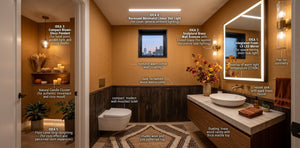
Best Flush Mount Lighting Ideas for Low Ceiling Chicago Condos
How to preserve headroom, control glare, and build useful layers without making compact rooms feel flat
The Best Fixture Is the One That Solves the Room
A low ceiling turns lighting into a clearance problem, a glare problem, and a design problem at the same time. A pendant can crowd the view; a tiny flush mount can leave corners dull; and an exposed bright source can feel harsher because it sits close to eye level. The best flush mount is therefore not one universal model. It is the fixture whose depth, diameter, distribution, diffusion, and style fit the room, while other light sources handle reading, cooking, grooming, and artwork. This guide shows how to make that decision without sacrificing headroom or asking one ceiling fixture to do everything.
Start with the actual ceiling, not a stereotype about Chicago condos. The City of Chicago Building Code section on interior space dimensions sets a seven-foot minimum for habitable spaces and hallways in covered dwelling units and includes clearance rules for projecting elements. That is a regulatory minimum, not evidence that most condos have seven-foot ceilings. Chicago's housing stock spans many periods and building types, so measure the finished floor to ceiling, locate beams and sprinklers, record door swings, and check the condominium association's alteration process before choosing a dropped fixture.
Low profile does not mean low ambition. The U.S. Department of Energy Strategy Guideline: High Performance Residential Lighting organizes residential light as “ambient, task, and accent.” Let a broad flush mount provide the ambient layer, then use portable lamps, sconces, under-cabinet light, or picture light where tasks and focal points need more.
The same guide treats “control of glare” as a lighting-quality concern, especially relevant when a bright ceiling source is close to view. Its cove-lighting discussion notes “a sense of greater ceiling height”; that observation applies to indirect ceiling-brightening, so use it as a companion strategy rather than promising that every flush mount will make a room look taller.
For a direct profile comparison, Urban Ambiance's Stop Guessing: Best Lighting for Low Ceilings—Flush Mount vs. Recessed explains why flush mounts preserve headroom while recessed fixtures require suitable ceiling conditions.
Quantity matters too. The City of Chicago Building Code lighting provision includes a minimum artificial-illumination requirement for covered rooms, but a code minimum is not a complete living-room, kitchen, or work-from-home plan.
Peer-reviewed research in JAMA Ophthalmology found home lighting was a significant factor in clinic-to-home vision differences among older adults in its study. That research does not set a fixture target for Chicago condos, but it reinforces the practical point: preserve headroom without underlighting the activities that happen below it.
Eight Flush Mount Ideas That Work With a Low Ceiling
1. Choose a Wide, Shallow Diffuser for the Main Living Space
A broader luminous surface can spread ambient light more comfortably than a small exposed lamp, provided the fixture's documented output and distribution suit the room. Opal or frosted diffusion can reduce the direct view of bright LEDs. Keep the silhouette thin enough that it does not compete with windows, millwork, or artwork.
A flush mount should establish the ambient layer, not become the entire plan. As Urban Ambiance explains in Layered Lighting vs. Single Source Lighting: Which Design Improves Your Home Value?, task and accent sources fill the gaps left by one central fixture. Use that article for the layer definitions, not as proof that a lighting change will produce a particular resale return.
2. Use a Quiet Geometric Flush Mount When the View Is Already the Focal Point
In a condo with skyline windows, strong art, or detailed cabinetry, a low-profile disc, square, or restrained drum can support the composition without adding another visual centerpiece. Urban Ambiance's Statement Lighting vs. Minimal Fixtures: What Should Be Your Home's Focal Point? offers a useful scale principle: decide what deserves attention before selecting the ceiling fixture.
3. Pair the Ceiling Fixture With Wall Light in Narrow Rooms
Sconces can add a vertical layer without consuming floor or table space. Aim for reflected or diffused light where possible, and coordinate the sconce projection with circulation paths. Urban Ambiance's How a Small Apartment Used Wall Sconces to Create the Illusion of Space shows how wall light can add depth in a compact interior; the effect is perceptual, not added square footage.
4. Use a Softly Shaded Drum in Bedrooms
A shallow drum or fabric-look diffuser can soften the source while keeping the fixture close to the ceiling. Verify cleanability, shade material, lamp access, and the view from bed. Add bedside task lights so the ceiling fixture does not need to be uncomfortably bright for reading.
5. Choose a Compact Closed Profile for Entries and Halls
These circulation areas benefit from reliable ambient light and clear overhead space. Check door swings, closet doors, ceiling-mounted detectors, and the sightline from the main room. A repeated fixture family can connect a short hall and entry without making each ceiling a separate design event.
6. Treat the Kitchen Flush Mount as Fill Light
A central surface fixture may support circulation, but counters usually need task light that reaches the work surface without the cook casting a shadow. Under-cabinet or directional lighting can provide that layer. Urban Ambiance's 6 Smart Lighting Solutions for Low Ceilings gives a broader menu of compact ceiling, wall, and directional options rather than relying on one fixture type.
7. Use a Verified Bathroom Fixture and Keep Mirror Light Separate
A low-profile ceiling fixture can provide ambient light, but it is rarely the most flattering source for faces. Add mirror-level task light and verify the exact damp or wet marking for each location. Urban Ambiance's Bright Ideas: Why Layered Lighting Transforms Small Bathrooms pairs compact ambient light with vanity and accent layers. Product markings and local electrical requirements still control installation.
8. Add Indirect Light When the Ceiling Needs Visual Lift
A concealed cove, shelf light, or upward wall light can brighten the ceiling plane and reduce the contrast between a bright fixture and a dark ceiling. This is the context behind the DOE's greater-height observation. Confirm wiring, access, surface reflectance, and control compatibility before building an indirect detail.


Match the Fixture to the Room
The table below is a planning framework, not a substitute for photometrics or a room calculation. Fixture diameter alone does not determine coverage, and integrated LED output cannot be inferred from wattage or price.
| Room | Flush Mount Direction | Companion Layer | Verify |
|---|---|---|---|
| Living Room | Wide shallow diffuser or quiet drum | Reading lamp, wall wash, or picture light | Output, glare, diameter, depth, and dimming |
| Bedroom | Soft diffuser with low profile | Bedside task lights | View from bed, lamp access, and minimum dim level |
| Kitchen | Broad ambient fill | Under-cabinet and sink or island task light | Distribution, color quality, cleanability, and controls |
| Bath | Compact, suitably marked ambient fixture | Mirror-side or upper task light | Damp or wet marking, placement, and local requirements |
| Entry/Hall | Small repeated profile | Sconce or art accent where useful | Door swing, detectors, headroom, and box location |
Shop Beyond Style
A polished fixture can still disappoint if the light source is harsh, colors look flat, or the dimmer flickers. U.S. Department of Energy LED Basics recommends at least 80 CRI for interior light and explains that CRI is not a complete color-quality metric. NIST guidance on color rendering likewise emphasizes that the appearance of objects under artificial light matters to consumers while noting shortcomings in traditional metrics. Compare real samples when wood floors, art, upholstery, or skin tones are important.
For controls, ENERGY STAR guidance on light fixtures and dimmers warns that not every LED works well with every dimmer. Verify the fixture or lamp's approved dimmer list, minimum dim level, flicker behavior, and whether the source is replaceable. Do not assume an arbitrary flush mount is ENERGY STAR certified; the current program page focuses on covered downlight categories.
Profile and scale. Record overall depth, diameter, canopy dimensions, and the lowest projecting point. Mock up the footprint with paper before ordering.
Light output and distribution. Use delivered lumens and photometric information when available. Consider room size, surface colors, and where people sit or work.
Diffusion and glare. Check whether the lamp or LED array is directly visible from normal seated and standing positions. Opal diffusion can help, but actual brightness and geometry still matter.
Source and serviceability. For integrated LED, verify CCT, CRI, dimming, driver or module service path, and warranty. For replaceable lamps, record base, shape, dimensions, and maximum wattage.
Installation conditions. Verify junction-box position and rating, fixture weight, ceiling material, wiring condition, and any sprinkler or detector clearances. Do not move common-building systems without authorization.
Chicago Condo Installation Reality
A flush mount is physically compact, but installation may still involve shared-building rules, older wiring, ceiling repairs, or an inadequate electrical box. The City of Chicago adopts local luminaire provisions through its electrical code. That fact does not by itself determine whether a specific replacement needs a permit or association approval. Before work begins, confirm the current code, project scope, building requirements, and manufacturer instructions with the appropriate local professionals and condominium board.
| Before Ordering | Why It Matters | Evidence to Collect |
|---|---|---|
| Measure the Ceiling and Obstructions | Nominal ceiling height misses beams, doors, and projecting devices | Floor-to-ceiling height, lowest point, door arcs, and room dimensions |
| Inspect the Electrical Box | Fixture weight and canopy must suit the existing support and opening | Box type, rating, condition, location, and wiring |
| Check Association Rules | Condo declarations may govern work hours, contractors, and common systems | Written alteration process, insurance, and approvals |
| Confirm the Light Source | Integrated and replaceable sources have different service paths | Lumens, CCT, CRI, dimmer list, lamp data, and warranty |
| Plan Patching and Paint | A new canopy may expose old holes or an uneven ceiling | Canopy size, ceiling condition, finish match, and repair scope |
Frequently Asked Questions
1. How Low Should a Flush Mount Hang in a Chicago Condo?
There is no universal fixture depth. Measure the finished ceiling and all projecting elements, preserve required clearance, and compare the fixture's full installed depth with doors, circulation paths, and the room's proportions. Current code and site conditions govern.
2. Is a Flush Mount Better Than Recessed Lighting for a Low Ceiling?
A flush mount preserves headroom without requiring a recessed housing, while recessed lighting can keep the ceiling plane visually quieter when the plenum and construction allow it. Compare ceiling access, insulation conditions, glare, distribution, installation scope, and desired style.
3. How Large Should a Flush Mount Be?
Use room dimensions, fixture diameter and depth, furniture layout, documented output, and distribution together. A large shallow diffuser may serve a living room better than a small bright point source, but product photometrics and room finishes matter.
4. What Color Temperature Works in a Condo?
Warm white light often suits living rooms and bedrooms, while some homeowners prefer a slightly more neutral appearance in kitchens or work areas. Test samples and keep adjacent sources visually consistent. CCT describes color appearance, not brightness or color fidelity.
5. Can One Flush Mount Light an Entire Room?
It may provide general ambient light in a small room, but reading, cooking, grooming, artwork, and work surfaces often benefit from task or accent layers. Confirm the fixture's delivered output and distribution rather than assuming one central source is sufficient.
Quick Summary
The best flush mount for a low-ceiling Chicago condo is a measured choice, not a universal shape. Protect headroom, favor comfortable diffusion, match diameter and output to the room, and use task, accent, and indirect light to complete the plan. Verify color quality, dimmer compatibility, installation support, and building requirements before ordering.
Make Every Inch of Light Count
A compact ceiling fixture can make a room feel intentional, open, and beautifully balanced when every layer of light has a clear purpose.
Find the Right Flush Mount
Measure your ceiling height, consider the room’s everyday tasks and sightlines, then compare Urban Ambiance flush mount lighting by verified depth, diameter, light-source specifications, finish, and installation requirements.
Explore Urban Ambiance flush mount lighting and find a space-conscious fixture that brings polished style and purposeful illumination to your low-ceiling home.