Fall Living Room Lighting Ideas for Pacific Northwest Craftsman Homes
When Fall Arrives Before the Room Is Ready
A Pacific Northwest Craftsman living room can be beautiful in daylight and frustrating by late afternoon. Dark millwork, deep eaves, porches, mature trees, built-ins, and textured finishes can make a room feel grounded, but they can also leave reading chairs, corners, and fireplace walls underlit as fall advances. Flooding the room with one bright overhead source often erases the depth that made the space appealing. The better approach is to decide what the room needs to reveal, support, and preserve, then build the light in layers.
The seasonal need is real, but it is not identical across the whole Pacific Northwest. NOAA’s technical memorandum on Seattle describes “a pronounced though not sharply defined rainy season, and considerable cloudiness, particularly during the winter months.” The U.S. Naval Observatory’s 2026 Seattle table shows the interval from sunrise to sunset contracting sharply from early September through November. Those sources make Seattle and Puget Sound a useful western-Washington example, not a climate rule for coastal Oregon, inland Washington, Idaho, or every mountain community.
For the style vocabulary, Urban Ambiance’s guide to Craftsman-style lighting is a useful starting point: simple lines, geometric forms, metal, clear or stained glass, and limited ornament. It is design guidance, not proof that a new fixture is historically original or handmade.
Build a Three-Layer Fall Lighting Plan
The three layers should work together, but they do not have to be equally bright. Each layer should solve a distinct job and, where practical, operate separately so the room can shift from cleaning to reading to a quiet evening.
The architecture gives the lighting plan its second constraint. A City of Seattle landmark report says, “The living room was the symbolic ‘heart of the family life’ and the fireplace and hearth were the focal points.” A National Park Service record for a Vashon Island Craftsman highlights natural local materials, exposed wood, leaded glass, built-ins, and a relationship to the landscape. Meanwhile, the Department of Energy states, “Lighting is typically considered as functioning in three layers: ambient, task, and accent.” Together, those ideas point toward a room that remains centered on its hearth and woodwork while becoming easier to use after dusk.
A layered plan can make early fall evenings more useful and welcoming without flattening the woodwork, hearth, and quiet structure that give a Craftsman room its character.
Start With the Room, Not a Fixture Trend
Before shopping, stand in the living room at the time it normally begins to feel dim. Note the ceiling height, exposed beams, fireplace sightline, built-ins, leaded or stained glass, window direction, dark corners, and the furniture people actually use. Then identify the missing job: general visibility, reading light, a brighter conversation area, or restrained emphasis on the architecture.
| Layer | Job in the Room | Craftsman-Sensitive Options | Control Idea |
|---|---|---|---|
| Ambient | Comfortable general visibility and circulation | Scaled chandelier, pendant, semi-flush, flush mount, or indirect light that clears beams and sightlines | Separate switch or compatible dimmer |
| Task | Reading, handwork, games, or a small desk | Table lamps, floor lamps, or adjustable sconces placed beside actual seats and work surfaces | Local switch at the activity |
| Accent | Reveal the hearth, built-ins, art glass, wood grain, or artwork | Picture lights, restrained sconces, or directional sources aimed away from direct sightlines | Separate switch or low-level scene |
The same framework appears in Urban Ambiance’s comparison of layered and single-source lighting. Use that article for design and function; its real-estate-value language is not evidence of a guaranteed increase in resale or asking price.


Eight Fall Lighting Ideas That Respect Craftsman Character
1. Keep the Hearth as the Visual Anchor
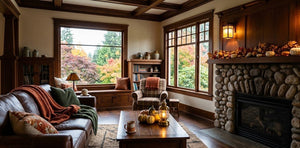
If the fireplace is the historic center of the room, avoid letting a large ceiling fixture compete with it. Use the ambient fixture to establish the room, then add restrained light at the mantel, masonry, or flanking built-ins. Aim for texture and depth, not a theatrical spotlight.
2. Put Reading Light Where Reading Happens
Place a table or floor lamp beside each chair used for reading, knitting, games, or homework. A lower, local source can make the seat useful without forcing the whole room to a higher light level. Shade opacity, bulb position, and sightline matter as much as style because an exposed bright source can create glare.
This activity-first approach is also central to our guide to setting the right tone with living-room lighting, which connects fixture types to reading, handwork, conversation, and softer evening use.
3. Choose a Central Fixture That Clears the Beams
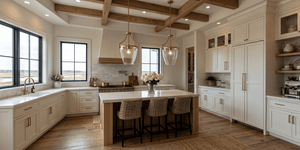
A squared-frame chandelier, low-profile pendant, semi-flush mount, or flush mount can echo Craftsman geometry. The choice depends on ceiling height, beam depth, fixture dimensions, hanging range, furniture layout, and required support. A fixture should not interrupt the fireplace view or create a collision point in a circulation path.
4. Use Wall Light to Reveal Built-Ins and Woodwork
Vertical surfaces shape perceived brightness. A sconce, picture light, or carefully aimed lamp can bring out book spines, grain, art, tile, or plaster without washing the whole room flat. In a historic interior, preserve character-defining fabric and avoid unnecessary holes; existing boxes and wiring may be a better constraint than perfect symmetry.
5. Treat 2700K to 3000K as a Starting Test
The Department of Energy explains that lower correlated color temperatures appear warm and higher values appear cool. For wood-rich living rooms, 2700K to 3000K is a useful starting range, not a universal answer. Buy or borrow one compatible lamp and test it after sunset against the stain, paint, textiles, art glass, and fireplace before standardizing the room.
For more context, see Urban Ambiance’s warm-versus-cool lighting guide. Its 2700K to 3000K range is a design starting point; task visibility and personal preference may lead to another choice.
6. Let Glass and Shade Materials Manage Glare
Clear glass keeps a fixture visually open and can create sparkle, but it exposes the lamp and may feel harsh in a direct sightline. Opal, amber, mica-like, or textured shades can soften the source and complement Craftsman materials, but they change the amount and direction of visible light. Confirm the exact fixture specifications and do not assume shade color alone tells you how bright the room will feel.
7. Create Separate Evening Scenes
Keep ambient, task, and accent sources on separate controls where practical. A cleaning scene may use the central source and most lamps; a reading scene may keep one task lamp and low ambient light; a conversation scene may emphasize the hearth and two or three pools of light. Verify that the fixture, lamp or driver, and dimmer are compatible before installation.
8. Start With Portable Light Before Rewiring
Move existing lamps beside activities, correct dark corners, and test lamp color before replacing a ceiling fixture. This sequence can reveal whether the room is missing a layer or whether the primary fixture is genuinely the problem. Portable lighting is also reversible, useful in historic interiors where plaster, woodwork, or wiring deserves extra care.
Seasonal cohesion matters too. Our fall home-styling guide recommends working with materials and finishes already present instead of adding unrelated autumn accents. In a Craftsman room, that may mean repeating an existing bronze tone, dark iron detail, wood species, or glass color rather than introducing a new theme.
A Lower-Risk Upgrade Order for Fall
- Observe the room after sunset and mark the seats, pathways, surfaces, and architectural features that disappear.
- Reposition portable lamps so task light comes from beside the activity rather than from across the room.
- Test one lamp color and brightness in the actual fixture, shade, and evening conditions.
- Add the missing task or accent source before replacing every fixture.
- Add dimming or new hardwired locations only after checking lamp, driver, control, box, circuit, and wiring compatibility.
- Replace the main fixture when scale, glare, distribution, or style remains unresolved after the other layers are working.
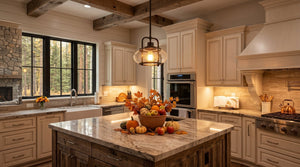
For a nearby regional precedent, our Pacific Northwest fall-lighting guide applies the same ambient, task, accent, and control logic to kitchens. Its room-specific layout advice should not be copied into a living room without considering seating and architecture.
Measure and Verify Before Buying
| Check | What to Verify |
|---|---|
| Room Fit | Room dimensions, ceiling height, beam clearances, furniture plan, fireplace sightline, and circulation |
| Fixture Fit | Width, height, canopy, hanging range, cord or chain length, wall projection, and mounting orientation |
| Electrical Fit | Voltage, bulb base and count, maximum wattage, integrated versus replaceable light source, dimmer compatibility, and junction-box support |
| Light Quality | Published lumens, CCT, CRI when disclosed, shade diffusion, glare, and direction of light |
| Location and Installation | Dry or damp rating as the actual location requires, listed instructions, fixture weight, wiring condition, and local requirements |
| Ownership | Warranty, replacement-lamp or component path, cleaning access, and finish-care instructions |
Older wiring, shallow or unsupported boxes, fragile plaster, and heavy fixtures can turn a cosmetic change into electrical work. A qualified electrician should assess uncertain wiring, moved boxes, new controls, support, or any condition the manufacturer’s instructions or local requirements place outside the homeowner’s experience.
Balanced Tradeoffs
| Choice | Potential Benefit | Tradeoff to Check |
|---|---|---|
| Warm-Appearing Light | Can flatter wood and create a softer evening mood | May feel too amber or insufficiently crisp for detailed tasks |
| Clear Glass | Preserves openness and sparkle | Exposes lamps, glare, and dust |
| Diffusing Shades | Soften the source and reduce direct brightness | Change output, distribution, and color appearance |
| Large Statement Fixture | Can anchor the seating group and echo Craftsman geometry | May compete with beams or hearth and can require stronger support |
| Integrated LED | Can create a clean form and coordinated light source | Serviceability and dimmer compatibility differ by model |
| Replaceable Lamps | Allow future changes in brightness and color | Lamp shape and visibility may affect the fixture’s appearance |
Preserve the Character, Improve the Light
A thoughtful fall lighting plan can make your Craftsman living room warmer and more functional after dusk while preserving the architectural character that makes the space worth celebrating.
Create Your Fall Lighting Plan
Take a look at your living room after sunset and identify which lighting layer is missing—ambient, task, or accent. Then explore Urban Ambiance lighting and compare fixtures by verified size, light source, controls, installation requirements, and finish.
Explore Urban Ambiance lighting to find fixtures that bring warmth, depth, and inviting illumination to your Craftsman living room this fall.