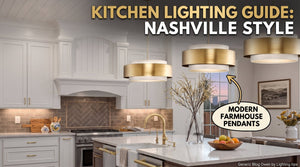
Kitchen Pendant Lighting Guide for Nashville Modern Farmhouse Kitchens
A measure-first approach to island scale, sightlines, task light, farmhouse character, controls, and installation planning
Start With the Island and the Work
Kitchen pendants sit at the intersection of architecture, task light, and decoration. In a Nashville modern farmhouse kitchen, they may need to illuminate chopping and serving, hold their scale against a long island, preserve views into an open living area, and connect wood, painted cabinetry, stone, and metal without becoming a barn-themed costume. The best result begins with the island's dimensions and the room's work zones, then selects fixture count, diameter, shade, hanging position, and controls as one coordinated system.
The regional label deserves restraint. Metro Nashville Historical Commission publications document a wide range of local architectural periods and house types, while Nashville's conservation guidelines emphasize that every building and site is different. Modern farmhouse is therefore best treated as a contemporary interior vocabulary, not one official Nashville historic style. Use clean silhouettes, natural or painted wood, clear or opal glass, and a limited set of black, bronze, or warm-metal accents; let the existing house and kitchen determine how rustic or modern the balance should be.
The functional case for pendants is stronger than the style case alone. The U.S. Department of Energy and NREL Strategy Guideline: High Performance Residential Lighting explains that pendants can provide “task lighting in areas without overhead cabinetry.” It also notes that “Undercabinet lights prevent shadows,” which is why island pendants should work alongside counter lighting rather than replace it.
For islands and peninsulas, the report says “Pendants may be substituted for recessed downlights,” but the surrounding passage treats them as one component of a broader ambient and task plan. Urban Ambiance's 20 Lighting Ideas for a Timeless Kitchen reinforces that practical relationship: pendants, recessed or ceiling light, under-cabinet light, and other layers should feel visually coherent instead of competing.
Local requirements belong on a separate verification track. Metro Nashville's adopted codes page lists the 2024 International Residential Code, 2024 International Energy Conservation Code, and 2023 National Electrical Code with local amendments.
Metro Nashville's building permit process also states that projects involving electrical work require the applicable trade permits and inspections. That does not prove every like-for-like pendant swap needs a permit. It does mean that new wiring, relocated boxes, added circuits, or structural support should be scoped with current local guidance and qualified professionals before fixtures are ordered.
Eight Decisions That Shape a Successful Pendant Plan
1. Name the Pendant's Job
Decide whether the fixture is primarily task light, ambient fill, a visual marker for the island, or a combination. An opaque metal shade may direct useful light downward but leave the ceiling darker; clear glass preserves views but can expose a bright lamp; opal glass softens the source but changes the distribution. The right choice follows the job, not the farmhouse label.
2. Measure the Island Before Choosing the Fixture Count
Record island length, width, counter height, seating positions, sink or cooktop locations, and the centerlines of existing electrical boxes. Urban Ambiance's 9 Ways to Update Your Kitchen Island with Lighting correctly puts scale, hanging height, spacing, and finish in the same decision. Treat any published dimensions as starting points and test them against the actual island and fixture.
3. Choose One, Pair, Trio, or Cluster by Composition
A single substantial pendant can center a compact island; a pair can create calm symmetry; three smaller fixtures can distribute rhythm across a longer surface; and a cluster can act as sculpture where task light comes from elsewhere. How to Choose the Right Pendants for Your Kitchen Island illustrates these layouts as visual options. The number is not a trend contest; it must fit the island, fixture diameter, light distribution, and box locations.
4. Set Height by Sightlines and Useful Light
Common hanging ranges can help with a mockup, but they are not universal rules. Tape a paper silhouette at the proposed bottom height, then check views from standing and seated positions, head clearance, glare, cabinet doors, and the fixture's documented minimum and maximum hanging range.
The transferable lesson from Pendant Lights Over Kitchen Islands in West Coast Open Concept Homes: What to Know Before You Install is to measure before buying and protect open-plan sightlines; its West Coast framing is not Nashville evidence.
5. Balance Shade Shape With Glare and Cleaning
Open shades can focus light on the counter but may expose the lamp. Clear glass keeps the room visually open but shows fingerprints and cooking residue. Seeded glass changes sparkle more than it guarantees diffusion. Opal or frosted glass often hides the source more effectively. Review the exact shade opening, lamp position, and cleaning access rather than selecting from a styled photo alone.
6. Keep Modern Farmhouse Materials Edited
Matte black can sharpen pale oak and white cabinetry; bronze or aged brass can warm stone and painted wood; clear or opal glass can reduce visual weight. Urban Ambiance's Modern Farmhouse Lighting Tips for a Warm Layered Home combines clean lines with restrained rustic detail, while How to Add Hanging Lights to Your Farmhouse Aesthetic offers additional ways to relate pendants to cabinetry, hardware, and natural materials. Use both as style guidance, not proof of Nashville preferences or product durability.
7. Select the Light Source With the Shade
Record whether the source is integrated or replaceable, then verify delivered lumens when published, CCT, CRI, lamp base and shape, maximum wattage, enclosure suitability, and dimming. A visible bulb becomes part of a clear-glass pendant's design; an oversized LED lamp may not fit the shade even when the base matches.
8. Plan Dimming and Scenes Before Installation
Island pendants may need bright output for preparation and lower output when the kitchen becomes part of an evening living space. Verify the lamp or driver against the dimmer and expected load. Do not assume that every LED and phase-cut dimmer combination will dim smoothly, quietly, or to the same low level.
Match Pendant Form to Kitchen Conditions
The table below is a design framework, not a product ranking. Exact output, distribution, glare, weight, and installation requirements must come from the current fixture documents.


| Kitchen Condition | Pendant Direction | What It Can Solve | Verify |
|---|---|---|---|
| Open Plan With Long Views | Clear or visually light shade | Preserves connection across rooms | Lamp glare, reflections, and cleanability |
| Dark Island Surface | Downward task-oriented shade | Places light where reflectance is low | Delivered output, beam spread, and shadows |
| Vaulted or Sloped Ceiling | Adjustable stem, chain, or cable system | Aligns pendants over the island | Sloped-ceiling compatibility, canopy, and hanging limits |
| Compact Island | One scaled pendant or small pair | Avoids crowding the work surface | Diameter, edge clearance, boxes, and sightlines |
| Long Island With Multiple Zones | Pair or trio with even rhythm | Defines prep, seating, or serving zone | Distribution, spacing, box centers, and obstructions |
Light Quality and Control Checks
Color appearance and color rendering are separate decisions. ENERGY STAR downlight criteria explains that 2700 K to 3000 K light appears warmer, but those criteria apply to covered downlights, not every pendant. In a farmhouse kitchen, test the source against cabinet paint, wood, stone, metal, food, and skin tones. Keep adjacent sources visually consistent unless the contrast is deliberate, and do not infer brightness from color temperature.
For dimming, NEMA SSL 7A establishes basic compatibility requirements for forward phase-cut dimmers combined with dimmable LED light engines. The practical lesson is simple: verify the tested lamp, driver, dimmer, and load combination. Compatibility is a system property, not a generic feature of the word dimmable.
Color temperature. Treat 2700 K to 3000 K as a warm-white test range, not a universal task-lighting rule. Compare real samples at daytime and night.
Color rendering. Check CRI and fuller color information when available. A single number does not capture every saturated color or preference.
Minimum dim level. Ask how low the actual lamp or integrated source will dim with the specified control and whether it flickers, steps, or changes appearance.
Output and distribution. Use delivered lumens and photometrics when published. Shade geometry can send most light down, out, or into the ceiling.
Service path. For integrated LED, verify driver or module replacement and warranty. For socketed fixtures, confirm lamp access and dimensions.
Nashville Installation Reality
Pendant planning can change from decoration to construction when boxes move, multiple fixtures replace one, a heavy fixture needs new support, or a vaulted ceiling requires a special canopy. Metro Nashville has adopted the 2023 National Electrical Code with local amendments, and its permit guidance should be checked for the actual scope. If the home is within a historic overlay, exterior work may trigger separate review, but an interior pendant is not automatically a historic-zoning issue. Confirm the property, scope, and current rules rather than assuming.
Support deserves the same attention as style. UL electrical equipment guidance notes that luminaires over 50 pounds intended for outlet-box connection carry an independent-support marking. A lighter fixture can still exceed the rating of an existing box, so the exact fixture weight, box listing, mounting instructions, and ceiling structure must be verified for every installation.
| Before Ordering | Why It Matters | Evidence to Collect |
|---|---|---|
| Measure Island and Room | Count, height, and spacing depend on the actual geometry | Island dimensions, ceiling height, seating, and sightlines |
| Locate Boxes and Systems | Ideal visual spacing may conflict with framing, ducts, or existing wiring | Box centers, structure, utilities, and access above |
| Confirm Fixture Package | Canopy, rods, chain, shades, and lamps affect the installed result | Included parts, dimensions, weight, hanging range, and instructions |
| Verify Source and Controls | Dimming and color must work across the whole kitchen | Lumens, CCT, CRI, lamp or driver, dimmer list, and load |
| Scope Permits and Labor | Relocated wiring and support can change cost and schedule | Current Metro guidance, contractor scope, inspections, patching, and paint |
Frequently Asked Questions
1. How Many Pendants Should Go Over a Kitchen Island?
There is no universal number. Island length and width, fixture diameter, distribution, ceiling height, seating, work zones, box locations, and sightlines determine whether one, two, three, or a cluster fits. Mock up the layout before ordering.
2. How High Should Pendants Hang Above an Island?
Use common design ranges only as a starting point. Check the manufacturer's hanging range, user heights, seated and standing sightlines, glare, task coverage, and head clearance. A full-size paper or temporary mockup is more reliable than a rule alone.
3. Are Clear Glass Pendants Good for a Modern Farmhouse Kitchen?
They can preserve views and add visual lightness, but the lamp remains visible, and glare, reflections, and cleaning may become more noticeable. Choose the bulb shape and output with the fixture, and consider opal or diffusing glass when visual comfort is the priority.
4. What Finish Works Best in a Nashville Modern Farmhouse Kitchen?
Black, bronze, aged brass, warm metal, wood, and glass can all work. Relate the finish to cabinetry, hardware, plumbing, appliances, and the home's architecture. A limited repeated palette usually feels more intentional than matching every metal exactly.
5. Do Island Pendants Replace Under-Cabinet Lighting?
Usually not. Pendants can light an island or peninsula, while under-cabinet lighting targets perimeter counters and reduces shadows cast by the person working there. Treat them as complementary layers and verify the output of each source.
Quick Summary
A strong Nashville modern farmhouse pendant plan begins with island dimensions, work zones, and sightlines. Choose fixture count, scale, shade, height, material, and light source together; layer pendants with ambient and under-cabinet light; then verify dimmer compatibility, box support, hanging range, and local project requirements.
Balance Character With Proportion
When proportion and performance come first, farmhouse lighting can feel warm, inviting, and current without making the kitchen feel heavy or overly themed.
Plan Your Island Lighting
Measure your kitchen island, mock up pendant sizes and sightlines, then compare Urban Ambiance pendant lighting by verified dimensions, light output, light-source requirements, fixture weight, and installation specifications.
Explore Urban Ambiance pendant lighting and find a fixture that brings the right balance of farmhouse warmth, functional illumination, and timeless style to your kitchen island.