Small Half-Bath Lighting Ideas for a Modern New York Townhouse: Warm and Welcoming Fall Style
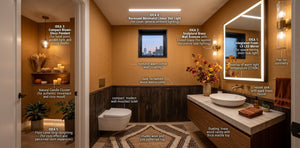
Warm and welcoming fall style with clear mirror light, compact layers, and New York installation planning
A Small Room Needs More Than a Small Fixture
A half-bath has a reduced program, but the lighting still has several jobs. Guests need comfortable mirror light, the room needs enough general visibility for cleaning, and a narrow plan should not feel harsher because one bright source sits close to the face. Warm fall style adds color, texture, and atmosphere, but it should remain a flexible seasonal layer rather than an excuse for weak task light. The best plan begins with the mirror and circulation path, then adds only the layers the room can use.
New York townhouse context varies by age, designation, and alteration history. The New York City Landmarks Preservation Commission Rowhouse Manual describes rowhouses as the dominant housing type in many city historic districts, but the manual focuses on exterior preservation and not every townhouse is designated.
For interior lighting, measure the actual room, note surviving trim, plaster, mirror recesses, and junction boxes, and check landmark status only where relevant.
A modern townhouse can mean a renovated historic rowhouse, a newer infill house, or a contemporary interior inside an older shell; the lighting should respond to the real building rather than the label.
New York City's own residential guidance offers a practical warm-light framework. The New York City Department for the Aging Aging in Place Guide for Building Owners advises owners to “Buy bulbs with a warm color temperature,” recommends “Use two or more fixtures to avoid shadows,” and suggests “Aim lights at a ceiling or wall surface.”
In a half-bath, those ideas translate into warm-looking but useful mirror light, a second ambient or accent source when the room needs it, and reflected light that softens contrast. The guide is accessibility-oriented and informational; it is not current electrical-code approval or a universal townhouse formula.
The mirror remains the priority. The U.S. Department of Energy Strategy Guideline: High Performance Residential Lighting explains that side and upper light can reduce facial shadows, while indirect or wall-wash approaches can control glare and visually expand a compact room.
Urban Ambiance's Bright Ideas: Why Layered Lighting Transforms Small Bathrooms reaches the same practical conclusion: separate ambient, mirror-task, and accent roles instead of relying on one ceiling bulb.


Eight Lighting Ideas for a Warm Fall Half Bath
1. Flank the Mirror When Wall Width Allows
Slim sconces beside the mirror can place light closer to face level and reduce the eye and chin shadows created by overhead light alone. Confirm mirror width, user heights, fixture projection, door swing, and box locations. If side sconces will not fit, use a well-diffused upper bar sized to the mirror and supplement with gentle ambient light.
Urban Ambiance's Your Ultimate Lighting Guide Part 2: Bedrooms and Bathrooms specifically discusses guest baths with only a sink and toilet. Treat its placement dimensions as starting points; verify the mirror, users, fixture output, and actual junction boxes.
2. Use a Slim Ceiling Fixture Only When It Adds a Needed Layer
A compact flush mount can improve circulation and cleaning light without crowding the ceiling. In a very small, open powder room, one excellent vanity fixture may sometimes provide enough general light. The decision should follow the fixture's documented output and distribution, wall reflectance, and room geometry rather than a rule that every half-bath needs a ceiling light.
The fixture comparison in Types of Light Fixtures for Layered Bathroom Lighting helps distinguish mirror, ceiling, and accent roles. Its older waterproof language should not be used as a product rating; exact markings still govern.
3. Bounce Light From a Pale Ceiling or Selected Wall
A concealed shelf light, shaded sconce, or compact wall washer can brighten a vertical surface and soften the contrast around the mirror. This is the useful meaning behind the NYC guide's indirect-light recommendation. Choose the target surface deliberately: warm off-white, muted clay, or olive may reflect enough light while still carrying fall color.
4. Build Fall Warmth With Finishes Before Lowering Output
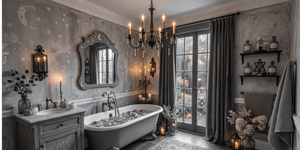
Warmth can come from aged brass, bronze, walnut, rust, olive, oxblood, woven texture, art, and a shaded or opal-glass source. Urban Ambiance's Warm Up Your Space: Master Bath Makeovers for Fall pairs dimmable layers with warm finishes and restrained accent light. Transfer the palette and lighting method to a half-bath without importing master-bath assumptions about tubs, showers, or wet zones.
5. Keep One Decorative Focal Point
A sculptural sconce pair, a vintage-inspired mirror, or a compact ceiling fixture can provide personality. Let only one lead. In a narrow room, a heavy fixture, elaborate wallpaper, dark vanity, and ornate mirror can compete for the same visual space. Edit the palette so the lighting supports the townhouse's larger modern language.
6. Use the Mirror to Distribute Light Rather Than Multiply Glare
A larger mirror can redirect both daylight and electric light, but visible lamps and glossy tile may create distracting reflections. Check seated and standing views from the doorway. Opal or frosted glass often conceals the source more effectively than clear or seeded glass, though exact brightness and geometry still matter.
The compact-space lesson in How a Small Apartment Used Wall Sconces to Create the Illusion of Space is useful here: wall-mounted light preserves scarce surfaces and adds vertical depth. The effect is perceptual, not added square footage, and the apartment example is not a townhouse or bathroom case study.
7. Create a Bright Scene and a Softer Guest Scene
A dimmer can let the same room shift from cleaning and grooming to a lower evening setting, but source and control compatibility must be verified. If the room has more than one layer, keep controls intuitive. Guests should not need to solve a switch puzzle to find usable mirror light.
8. Add Low-Level Light Only When It Solves a Route
A shielded under-vanity or baseboard-adjacent source can provide nighttime orientation, especially when the half-bath sits off a hall. Keep the source out of direct view and away from kicking or cleaning damage. Do not use decorative low-level light as the only illumination for a step, threshold, or wet floor.
Match the Layer to the Job
The table below is a planning framework, not a fixture schedule. Exact output, glare, color quality, and controls must come from current product documents and the room's dimensions.
| Layer | Primary Job | Warm Fall Expression | Verify |
|---|---|---|---|
| Mirror Task | Reveal face and sink area | Warm metal or dark frame with soft diffusion | Output, projection, mirror clearances, and dimming |
| Ambient | Support circulation and cleaning | Slim flush mount or reflected ceiling light | Distribution, glare, ceiling conditions, and control |
| Accent | Add depth and emphasize art or texture | Wall wash on clay, olive, wallpaper, or wood | Aim, reflections, surface color, and source shielding |
| Low Level | Support nighttime movement | Concealed under-vanity glow | Source visibility, durability, and separate control |
Color Quality, Controls, and Ventilation
Warm appearance is not the same as dimness or color fidelity. NIST's lighting and color perception guidance explains that color rendering describes how objects appear under a source and also cautions that traditional metrics do not capture every aspect of perception. Test cabinet paint, metal, art, skin tones, and fall colors under the actual lamp or integrated source.
For dimming and color temperature, ENERGY STAR light fixture guidance explains that lower Kelvin values appear warmer and warns that not every LED works well with every dimmer. Its current program scope centers on covered downlight categories, so do not imply certification for an arbitrary decorative sconce or flush mount. Verify the exact fixture, lamp or driver, dimmer list, load, and minimum dim level.
A half-bath without a shower or tub is not automatically a damp or wet location. UL environmental location guidance reserves damp- and wet-location use for luminaires marked accordingly. Select the rating from actual exposure, product instructions, and code requirements, not the room label alone. Ventilation also remains a project question: the NYC Building Code addresses natural or mechanical ventilation for toilet rooms, and an interior room cannot borrow natural ventilation through another room.
Color temperature. Use the NYC guide's 2700 K to 3000 K range as a warm starting point, then compare samples. CCT does not describe brightness.
Color rendering. Check CRI and fuller color information when available, but judge the actual finishes and faces in a mockup.
Dimmer compatibility. Verify the lamp or driver, control, and load together. Ask about flicker, noise, minimum dim level, and restart behavior.
Enclosed fixtures. NYSERDA cautions that not every LED replacement bulb suits a fully enclosed fixture. Check the lamp and fixture specifications.
New York Installation Reality
A small room can still create a complicated scope when junction boxes move, old wiring needs correction, wall tile or plaster must be opened, or a landmark property is involved. The current 2025 NYC Electrical Code governs new and modified electrical systems. Permit, filing, and professional requirements depend on the exact work, so confirm the path before selecting fixtures around an assumed box location.
The NYC Department of Buildings electrical project requirements states that installation and modification of electrical systems require a permit and a NYC Licensed Master Electrician. It also lists limited replacement and repair categories, including replacement of fixtures in existing outlets under stated conditions. Use the current page to scope the actual project rather than treating every bulb change, fixture swap, or rewiring job as identical.
For designated properties, the NYC Landmarks Preservation Commission permit guidance should be checked when interior work also requires a Department of Buildings permit. Most interior decorating is not landmark review, but designation and scope can change the approval path.
| Before Ordering | Why It Matters | Evidence to Collect |
|---|---|---|
| Measure Mirror and Room | Compact rooms leave little tolerance for projection or misalignment | Wall width, mirror dimensions, door swing, ceiling height, and sightlines |
| Locate Boxes and Surfaces | Ideal fixture placement may conflict with framing, plaster, tile, or wiring | Box centers, wall build-up, surface condition, and access |
| Verify Fixture Data | Style does not establish output, fit, rating, or compatibility | Dimensions, lumens, CCT, CRI, source, dimmer list, and location marking |
| Check Townhouse Status | Landmark designation and project scope can change approvals | Address research, designation, DOB filing, and LPC guidance |
| Scope Electrical Work | New boxes, wiring, or controls require qualified planning | Licensed electrician, permit category, inspections, patching, and paint |
Frequently Asked Questions
1. What Color Temperature Works in a Warm Half Bath?
New York City's aging-in-place guide uses 2700 K to 3000 K as a warm range. Treat it as a starting point, not a universal rule. Compare the actual source with paint, tile, metal, artwork, and skin tones, and judge brightness and color rendering separately.
2. Are Side Sconces Necessary in a Powder Room?
Not always, but mirror-side light can reduce facial shadows and preserve counter space. If the wall is too narrow, a well-diffused upper fixture may work with ambient or reflected light. Verify mirror dimensions, user heights, projection, and box locations.
3. Does a Half Bath Need a Ceiling Light?
Not automatically. A small open powder room may sometimes get sufficient ambient and task light from one good vanity fixture. Add a ceiling layer when the room's geometry, dark finishes, cleaning needs, or documented fixture distribution justify it.
4. Does Every Half Bath Need Damp-Rated Lighting?
No. A room without a shower or tub is not automatically damp or wet. Actual condensation or moisture exposure, the adopted code, the product marking, and manufacturer instructions determine suitability.
5. How Can a Tiny Powder Room Feel Warmer Without Looking Crowded?
Use a restrained fall palette, one focal fixture or mirror, soft diffusion, reflected light, and only the layers the room needs. Keep counters clear, repeat a limited set of finishes, and maintain a brighter scene for guests and cleaning.
Quick Summary
A welcoming New York townhouse half-bath starts with the mirror, then adds only the ambient, accent, or low-level layers the room needs. Use warm-looking light without sacrificing output or color quality, reduce shadows, bounce light from selected surfaces, keep fall styling restrained, and verify ventilation, location ratings, dimmer compatibility, and NYC installation requirements.
Make a Small Space Feel Considered
A compact room can feel generous when every source has a clear purpose and every finish earns its place.
Plan Your Half-Bath Lighting
Measure the mirror, wall projection, and existing electrical boxes, then map the lighting layers your space needs. Compare Urban Ambiance fixtures by verified dimensions, light output, color quality, controls, location rating, and installation requirements.
Explore Urban Ambiance lighting to find fixtures that bring warm illumination, thoughtful function, and elevated style to even the smallest bathroom.