Whimsigoth Bathroom Ideas for a New Orleans Historic Home: Moody Lighting for a Cozy Fall Retreat
Moody lighting for a cozy fall retreat that respects historic features, vanity visibility, moisture, and installation realities
Make the Mood Reversible and the Light Useful
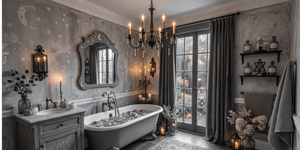
Whimsigoth can bring plum, ink, moss, celestial motifs, botanical forms, vintage-inspired metalwork, and pools of amber-looking light into a bathroom. In a New Orleans historic home, however, the room already has a visual history. Plaster, trim, transoms, tall ceilings, old doors, tile, hardware, or an earlier light fixture may matter more than a newly purchased theme. The most convincing approach treats whimsigoth as a contemporary, reversible decorating layer while the lighting plan continues to serve grooming, cleaning, bathing, and nighttime movement.
The preservation priority is clear in the National Park Service Preservation Brief 18. It advises owners to “Retain and preserve interior features and finishes” and to “Avoid making new cuts in floors and ceilings.” For a bathroom lighting project, that supports reusing suitable junction-box locations where practical, protecting ornamental plaster and trim, and choosing fixtures whose canopy and mounting strategy fit the existing surface.
The same guidance says that “wiring should be installed as inconspicuously as possible,” which makes a discreet electrical plan part of the design rather than an afterthought.
This does not mean a historic room must be frozen or that every interior change is reviewed by the city. The New Orleans Historic District Landmarks Commission states that its jurisdiction is over property exteriors. Its design guidelines still offer useful local context: New Orleans includes many building types and styles, and every property requires individual judgment. Whimsigoth is not listed as a historic New Orleans style, so borrow selectively from Victorian and Gothic silhouettes rather than presenting a new theme as restoration.
Urban Ambiance's An Exploration into Victorian Style can help identify curved metalwork, caged forms, and dramatic profiles to use sparingly; it is inspiration, not preservation evidence.
Mood also cannot replace a functioning vanity. The Illuminating Engineering Society article Accentuate the Positive explains the visibility value of soft vertical illumination from sconces or other sources. In a compact bath, Urban Ambiance's Bright Ideas: Why Layered Lighting Transforms Small Bathrooms similarly favors mirror-side light plus separate ambient and accent layers.
The practical conclusion is simple: create the moody scene with dimmable decorative and low-level light, while retaining a brighter, well-diffused scene for faces and cleaning.
Eight Whimsigoth Lighting Ideas That Respect the House
1. Let One Historic Feature Lead the Room
Choose the ceiling height, transom, plaster, old mirror, mantel-like trim, tile, or surviving fixture as the first focal point. Use paint, textiles, framed art, and removable celestial or botanical details around it. A dark ceiling can be dramatic, but test a large sample first; reducing ceiling reflectance can make the same fixture feel dimmer.
2. Frame the Mirror With Soft Vertical Light
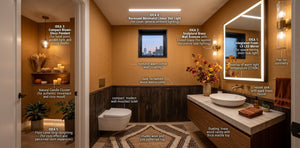
A pair of sconces can reduce the hard shadows created by overhead light alone. Check user heights, mirror width, medicine-cabinet doors, fixture projection, and junction-box locations. A candlelike silhouette or aged-metal backplate can carry the whimsigoth note without using a dim source for grooming.
This is where decoration and task light can cooperate. Wall Sconces or Table Lamps: Lighting Strategies to Elevate Your Space explores symmetrical wall light as a framing device; in a bathroom, exact placement and moisture suitability still require product and installation verification.
3. Use the Ceiling Layer for Visibility, Not Theatrics
A restrained flush mount, compact semi-flush fixture, or carefully placed recessed source can support circulation and cleaning while sconces carry more character. Avoid dropping a new ceiling below ornamental plaster or high-ceiling proportions. If the historic fixture remains, have its wiring, mounting, and allowable lamp type assessed rather than assuming it can accept a modern lamp or dimmer.
4. Create a Fall Scene With Lower Pools of Light
Under-vanity light, a shielded niche source, or a small wall accent can provide a calm evening route without turning on every layer. Urban Ambiance's Warm Up Your Space: Master Bath Makeovers for Fall shows how ambient, task, and accent light can make a bathroom feel cozier without a full remodel. Use fall as a palette and scene, not a reason to underlight wet floors or steps.
5. Make Moody a Scene Rather Than a Permanent Deficit
Put ambient, vanity, accent, and low-level light on logical controls so the room can shift from cleaning to grooming to evening use. Urban Ambiance's Incorporating a Dark and Moody Room into Your Bright and Sunny Home makes the same useful distinction between brighter functional light and a dimmer, cozier scene. Its trend framing is older editorial guidance, not evidence that one palette is currently dominant.
6. Use Color Quality to Keep Jewel Tones Intentional
Warm-looking light can support plum, burgundy, moss, brass, and dark wood, but color temperature does not measure color fidelity. The U.S. Department of Energy notes that 90-plus CRI indicates excellent color fidelity while also explaining CRI's limitations. Compare real samples and fuller color information when saturated reds, artwork, skin tones, and historic finishes matter.
7. Treat the Tub and Shower as Separate Lighting Zones
A decorative pendant or sconce near bathing areas may look atmospheric, but placement determines the required listing and installation limits. Use a shielded, appropriately marked source for the exact zone, then create drama on a nearby dry wall, alcove, or architectural feature. Never infer wet-location suitability from a bathroom photograph or sealed-looking shade.
8. Edit the Motifs Before the Room Becomes a Set
Choose two or three recurring ideas, such as moons and stars, botanical forms, antique brass, smoky glass, or a deep floral textile. Let fixtures repeat only one or two of those cues. For the retreat side of the brief, Urban Ambiance's How They Did It: A Spa-Like Bathroom Remodel That Works in Real Life offers a better principle than decorative accumulation: build calm through texture, indirect light, and separate scenes.


Build Four Lighting Layers
The table is a planning framework, not a fixture schedule. Exact output, beam spread, glare, control, and location rating must come from current product documents and the room's dimensions.
| Layer | Primary Job | Whimsigoth Expression | Verify |
|---|---|---|---|
| Vanity Task | Reveal the face and counter | Aged-metal or dark-framed sconces with diffusion | Output, projection, mirror clearances, and rating |
| Ambient | Support circulation and cleaning | Quiet ceiling fixture that does not obscure historic details | Glare, distribution, ceiling condition, and controls |
| Accent | Reveal texture, art, and architecture | Shielded light on plaster, tile, botanicals, or alcoves | Aim, heat, reflections, and moisture exposure |
| Low Level | Guide evening movement | Concealed under-vanity or niche glow | Source visibility, separate control, and service access |
Moisture and Evening Light Reality
A cozy bathroom still needs moisture removal. U.S. Environmental Protection Agency remodeling guidance advises that bathroom air should exhaust directly outdoors. Ventilation does not turn a dry-rated fixture into a damp- or wet-rated one, and a location-rated fixture does not replace ventilation. Check the fan's operation, exhaust path, and controls as part of the lighting plan, especially when new ceiling work could disturb ducts or historic finishes.
For fixture placement, UL environmental location guidance distinguishes damp from wet conditions and reserves wet locations for luminaires marked accordingly. Use the exact product label, installation instructions, and locally adopted code; do not assume every bathroom ceiling or wall has the same exposure.
A small bathroom study published in Sensors found that short evening exposure to conventional bathroom lighting influenced melatonin and alertness measures in nine young adults. That limited study supports giving homeowners control over a lower-stimulation evening scene, but it does not prove that a specific fixture, dimming level, or warm CCT improves sleep. Use the brighter scene whenever visibility is the priority.
Damp and wet markings. Verify the exact location, product label, listing restrictions, and manufacturer instructions. A decorative style name is not a safety rating.
Color appearance. Test warm-white sources against deep paint, tile, art, and skin tones. CCT describes appearance, not brightness or complete color quality.
Dimming. Confirm the lamp or integrated driver, dimmer, and load combination. Record the minimum dim level, flicker behavior, and whether the source changes appearance.
Historic surfaces. Document plaster, woodwork, tile, and prior penetrations before work. Choose canopy sizes and mounting methods that minimize damage and remain serviceable.
New Orleans Installation Reality
Historic character and local jurisdiction are separate questions. The HDLC generally reviews exteriors, while electrical work falls under the City's permit and code process. A project can avoid exterior review and still require an electrical permit. It can also preserve decorative details while needing new support, grounding, boxes, or wiring. Confirm the property address, historic-district status, exact scope, and current requirements before purchasing fixtures or opening walls and ceilings.
The City of New Orleans Electrical Permit page states that installation, repair, replacement, or alteration of electrical apparatus or equipment requires an electrical permit, with a narrow exception for bulbs and fuses. Verify how the current rule applies to the project and who may obtain the permit; do not assume a decorative fixture swap is exempt.
| Before Ordering | Why It Matters | Evidence to Collect |
|---|---|---|
| Survey Historic Features | Plaster, trim, transoms, tile, and old boxes may shape the least damaging plan | Photos, dimensions, materials, condition, and prior openings |
| Map Four Light Layers | Mood and task visibility need different sources and controls | Vanity, ambient, accent, and low-level zones |
| Verify Each Fixture | Appearance does not establish output, rating, or compatibility | Dimensions, weight, CCT, CRI, lumens, source, dimmer, and location marking |
| Inspect Wiring and Support | Historic homes may contain altered boxes, wiring, or finishes | Box rating, grounding, structure, access, and electrician scope |
| Confirm Permits and Reviews | City electrical and historic exterior processes have different jurisdictions | Address status, project scope, current City guidance, and approvals |
Frequently Asked Questions
1. What Does Whimsigoth Mean in a Bathroom?
It is a contemporary decorating shorthand rather than a documented New Orleans historic style. In this article, it means an edited mix of deep jewel tones, celestial or botanical motifs, vintage-inspired metalwork, dark wood, glass, and warm-looking layered light.
2. Can a Historic Bathroom Be Painted a Dark Color?
Possibly, but first identify significant plaster, woodwork, tile, stenciling, unpainted millwork, and other finishes. Test a large removable sample because dark surfaces absorb more light. Preservation guidance, property significance, and coating compatibility should inform the decision.
3. What Lighting Is Best at a Whimsigoth Vanity?
Use well-diffused vertical light beside the mirror when the room and boxes allow it, with an upper or ambient layer as needed. Choose the decorative silhouette separately from the task requirements, then verify output, glare, color quality, projection, and moisture suitability.
4. Do All Bathroom Lights Need a Wet Rating?
No. Required markings depend on exact exposure and placement. Wet locations can receive dripping, splashing, or flowing water, while damp locations involve moisture or condensation. Verify the product label, instructions, and local code for each location.
5. How Can the Room Feel Moody Without Becoming Unsafe?
Keep a brighter vanity and cleaning scene, then add a separate dimmable accent or low-level scene. Shield visible sources, illuminate changes in level and wet walking surfaces, and confirm that lamps, drivers, and controls are compatible.
Quick Summary
A successful whimsigoth bathroom in a New Orleans historic home layers contemporary mood around the existing architecture. Preserve significant features, minimize new cuts, keep wiring discreet, provide soft vertical vanity light, separate bright and evening scenes, ventilate outdoors, and verify every fixture's moisture rating and installation requirements.
Create Mood Without Losing Function
A room can feel darkly romantic and beautifully autumnal while still preserving its historic character, everyday visibility, and essential safety.
Build Your Lighting Plan
Document the room’s historic features, map out four complementary lighting layers, then compare Urban Ambiance fixtures by verified dimensions, light output, color quality, location rating, dimmer compatibility, and installation requirements.
Explore Urban Ambiance lighting to find fixtures that bring moody warmth, functional illumination, and timeless character to your historic space.