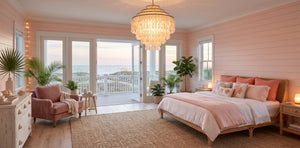
Pink Coastal Bedroom Ideas for a Florida Beach House: Soft Lighting for a Dreamy Summer Escape
Soft lighting for a dreamy summer escape with filtered daylight, layered evening scenes, and carefully rendered color
Dreamy Starts With Daylight Control
Pink can make a coastal bedroom feel soft and sun-washed, but Florida daylight can push the same palette toward peach, gray, or glare depending on window orientation and time of day. The room also needs more than a pretty ceiling fixture: guests or residents need general visibility, bedside task light, comfortable evening scenes, and controls that make sense. The best design begins with the windows, tests the actual pink materials, then builds ceiling, bedside, and accent light around the way the room is used.
The daylight strategy is not simply to make the room brighter. U.S. Department of Energy Energy 101: Daylighting explains that north-facing windows can offer “minimal glare and less summer heat,” while east- and west-facing windows can admit “excess heat and glare.” It also describes shading strategies that “let in light but keep out heat.”
In a Florida beach bedroom, that supports sheers paired with a solar shade, lined drapery, or another adjustable layer so the room can hold a soft pink palette without becoming washed out or uncomfortable in low-angle sun.
Florida research adds an important qualification. A Florida Solar Energy Center field study found that some very low-solar-gain dark-tint glazing transmitted little visible light, while spectrally selective glazing admitted more useful daylight. The 1998 study involved only two Florida houses and should not be turned into a product prescription. The durable lesson is to evaluate visible light, glare, and heat together rather than assuming the darkest tint will create the best bedroom.
Lighting also shapes how the room shifts from day to night. University of Florida research reported in A Good Night's Sleep Thanks to DCP Professor treats light as part of visual and nonvisual interior performance. The underlying systematic review focused on older adults and found an inconclusive evidence base, so this article does not promise that a pink palette, warm lamp, or tunable fixture improves sleep.
It does support a practical design choice: preserve bright, useful daytime and task light, then give the evening scene independent, lower-output controls.
Eight Pink Coastal Lighting Ideas for a Summer Bedroom
1. Choose the Pink Only After Testing Daylight
Tape large samples of blush, shell pink, dusty rose, or coral on more than one wall and view them in morning, afternoon, and electric light. A blue-based pink may feel cooler beside sea-glass green; a peach-based pink may intensify under warm lamps. Use the actual fabric, paint, wood, and metal samples rather than judging from a screen.
2. Filter the Window in Two Adjustable Layers
A sheer can soften the view and scatter daylight, while a second shade or lined curtain controls glare and privacy. Keep the hardware quiet and coastal rather than nautical: pale oak, white, soft brass, woven texture, or simple linen can carry the theme without anchors, ropes, or shells on every surface.
3. Use a Restrained Coastal Ceiling Fixture
A compact chandelier, pendant, flush mount, or fan light can provide the ambient base. The form should fit ceiling height, bed placement, and blade sweep where applicable. Urban Ambiance's Why a Beachy Chandelier Might Be the Only Summer Upgrade You Actually Need favors pale woods, woven texture, and soft-white light over literal nautical motifs. Use it as style guidance, not Florida climate or durability evidence.
4. Free the Nightstands With Bedside Sconces
Wall-mounted reading lights can preserve small tables for water, books, and personal items. Check the user's reading position, fixture reach, projection, switch location, cord or hardwire plan, and glare from bed. Urban Ambiance's Your Ultimate Lighting Guide Part 2: Bedrooms and Bathrooms uses bedside sconces as a compact-space tool; treat its placement numbers as starting points and field-check the actual bed and users.
5. Add a Low Pool of Light Instead of Overbrightening the Ceiling
A bedside lamp, reading lamp, or shaded corner light can provide a personal zone while the main ceiling source stays lower. The Best Places to Use Lamps in Home Decor recommends bedside and reading lamps for local pools of light. That is qualitative design guidance, not sleep research or a measured task-light target.
6. Build a Neutral Ambient Base Before Adding Pink Accents
Soft white walls, pale wood, natural fibers, and a diffused ceiling source can keep the room from reading as a single-color set. Introduce pink through one wall, a headboard, drapery, bedding, art, or a small glass accent, then repeat it once or twice. Beyond the Basics: Ambient Lighting Essentials treats ambient light as the foundation beneath task and accent layers.
7. Test Warm and Cool Sources Against the Palette
Warm-looking light can make blush and coral feel richer, but it can also push some whites yellow. A more neutral source may keep pale blue and crisp white clearer. Urban Ambiance's Warm or Cool Lighting: Which Works Best for Modern Home Interiors? shows how color temperature changes the way warm materials and whites read. Use real evening samples and keep adjacent sources visually consistent.
8. Create Separate Arrival, Reading, and Wind-Down Scenes
A bedroom may need a brighter arrival and cleaning scene, focused reading light, and a lower evening combination. Keep ceiling, bedside, and accent sources independently controllable. Fall Bedroom Lighting Trends for Better Sleep in Apartments, Condos, and Cozy Suburban Bedrooms offers transferable advice on layering and dimming, but its fall framing and sleep language are not Florida-summer evidence or a health guarantee.


Match Each Layer to a Job
The table below is a planning framework, not a fixture schedule. Exact output, glare, color quality, dimming, and installation requirements must come from current product documents and the room's geometry.
| Layer | Primary Job | Pink Coastal Expression | Verify |
|---|---|---|---|
| Daylight | Provide daytime visibility and connection | Sheer plus adjustable shade around a soft pink palette | Orientation, glare, privacy, visible light, and heat |
| Ambient | Support arrival, circulation, and cleaning | Diffused ceiling light in pale wood, woven texture, or quiet metal | Output, distribution, ceiling height, and controls |
| Bedside Task | Support reading and personal use | Sconce or lamp with a soft shade and compact footprint | Reach, glare, switch location, and projection |
| Accent | Add depth and emphasize art or texture | Small pool on coral glass, artwork, or a woven panel | Aim, reflections, source shielding, and dimming |
Color Quality and Evening Light
A pink room exposes weak color rendering quickly. U.S. Department of Energy LED Basics notes that 90-plus CRI indicates excellent color fidelity while also explaining the limitations of CRI, especially for saturated reds. When blush, coral, skin tones, and artwork matter, compare real sources and request fuller color data such as R9 or TM-30 when available.
The Illuminating Engineering Society: Using TM-30 to Improve Your Lighting Design explains how TM-30 adds fidelity and gamut information beyond a single CRI value. This is professional metric guidance, not a recipe for the most flattering pink. A mockup remains the most direct way to judge the complete palette.
Bedroom evenings also benefit from control. A small 2026 randomized crossover study in Behavioral Sleep Medicine compared several pre-bed lighting conditions in 24 adults. Its findings do not prove that a particular warm fixture improves sleep, but they support managing evening exposure rather than leaving the bedroom at one bright setting. Keep the brighter scene for cleaning and tasks and reduce output only when the room's activities allow it.
Color temperature. Compare warm and neutral samples with the paint, bedding, and daylight. CCT describes color appearance, not brightness or fidelity.
Color rendering. Check CRI and fuller metrics when available. Pink and coral can shift noticeably under sources with different red rendering.
Dimmer compatibility. Verify the lamp or driver, dimmer, and load together. Ask about minimum dim level, flicker, noise, and restart behavior.
Integrated versus replaceable. Confirm the service path, warranty, and replacement parts for integrated LEDs; record lamp base, shape, and enclosure suitability for socketed fixtures.
Florida Beach House Reality
A coastal address does not automatically make every conditioned bedroom a damp location, and it does not prove salt exposure at an interior fixture. Select environmental ratings from actual condensation, openings, screened porches, direct air pathways, and product instructions. Keep outdoor and semi-exposed recommendations separate from ordinary indoor-bedroom guidance.
Humidity still matters to the room as a whole. U.S. Environmental Protection Agency mold and moisture guidance states that moisture control is the key to mold control. That supports working air-conditioning, appropriate dehumidification, dry textiles, and proper building-envelope maintenance; it does not establish corrosion resistance or a damp-location rating for a specific light fixture.
If the bedroom ceiling includes a fan, ENERGY STAR ceiling fan installation guidance advises using an appropriate fan-rated box. Replacing a light with a fan or fan-light can change support, wiring, blade-sweep, and ceiling-clearance requirements. Coordinate any chandelier, pendant, or downlight with the fan's full blade and airflow zone rather than treating each product in isolation.
For environmental markings, UL luminaire guidance distinguishes dry, damp, and wet locations. Use the exact label, listing restrictions, manufacturer instructions, and locally adopted code for the installation. An ordinary air-conditioned bedroom is usually planned as a dry interior unless actual conditions establish otherwise.
| Before Ordering | Why It Matters | Evidence to Collect |
|---|---|---|
| Map Windows and Daylight | Orientation and shading change color, glare, and heat | Window direction, shade type, privacy, and daytime photos |
| Test the Pink Palette | Paint, fabric, and glass shift under different sources | Large samples, daylight, and evening mockups |
| Verify Each Fixture | Style does not establish output, color, or compatibility | Dimensions, lumens, CCT, CRI or TM-30, source, dimmer, and rating |
| Coordinate Fan and Light | Boxes, blades, airflow, and hanging fixtures share ceiling space | Fan-rated support, blade sweep, ceiling height, and wiring |
| Assess Actual Exposure | Coastal address alone does not establish damp or salt exposure | Room conditioning, condensation, openings, label, and instructions |
Frequently Asked Questions
1. Which Pink Works Best in a Florida Coastal Bedroom?
There is no universal best pink. Test blush, shell, dusty rose, and coral against the room's window orientation, white, wood, textiles, and evening light. A large movable sample is more reliable than a screen image or paint chip.
2. What Color Temperature Works With Pink Walls?
Warm light can enrich blush and coral but may yellow some whites; a more neutral source can keep pale blue and crisp white clearer. Test actual lamps or integrated sources and judge color fidelity and brightness separately from CCT.
3. How Can a Bedroom Feel Coastal Without Looking Themed?
Use a restrained palette of pink, shell white, pale wood, woven texture, sea-glass green, or quiet metal. Choose one or two coastal materials and avoid repeating literal nautical symbols across fixtures, bedding, and artwork.
4. Does a Florida Beach Bedroom Need Damp-Rated Lighting?
Not automatically. A conditioned interior bedroom is generally treated as dry unless actual condensation, direct exterior exposure, or another condition changes the classification. Verify the product marking, instructions, and local requirements.
5. Can a Ceiling Fan and Decorative Light Work in the Same Bedroom?
Yes, when ceiling height, fan-rated support, blade sweep, airflow, fixture projection, and wiring are coordinated. A fan-light combination may be simpler in compact rooms; separate decorative lighting requires careful spacing and installation review.
Quick Summary
A dreamy pink coastal bedroom begins with controlled daylight, then layers a diffused ambient source, personal bedside light, and a restrained accent. Test pink materials under the actual windows and evening lamps, protect color fidelity, keep scenes independently controllable, coordinate any ceiling fan, and verify environmental conditions rather than assuming every Florida beach-house bedroom needs a damp-rated fixture.
Keep Coastal Style Soft and Intentional
The room can feel soft, summery, and transportive while maintaining useful illumination and expressing coastal style through color, texture, and atmosphere rather than obvious seaside symbols.
Create Your Coastal Lighting Plan
Map the natural light from your windows, test your pink palette, and plan complementary ceiling and bedside lighting layers. Then compare Urban Ambiance fixtures by verified dimensions, light output, color quality, controls, support requirements, location rating, and installation specifications.
Explore Urban Ambiance lighting to find fixtures that bring soft illumination, relaxed elegance, and a dreamy coastal character to your bedroom.